

With the popularization of smart homes, with the support of AI, home security systems are gradually improving and becoming smarter.Smart doorbell/cat eye/door lockAs the first line of defense, users can promptly grasp any changes at the door of their home; the battery IPC is no longer bound by wiring, and the installation area is not restricted. It can monitor the surrounding areas or blind spots in an all-round way, greatly improving the level of home security.
The new generation of machine vision solutions uses RV1106 and RV1103 chips, which have significantly upgraded performance in NPU, ISP, video encoding, audio processing, etc., and are characterized by high integration, high cost performance, and low standby power consumption. It can be applied to low-power battery-based IPC products.
The biggest difference lies in two aspects
1. RV1106 supports 5 million pixels, and RV1103 supports 4 million pixels;
2. RV1106 matches 1Gb/2Gb DDR3 memory, and RV1103 matches 512Mb memory.
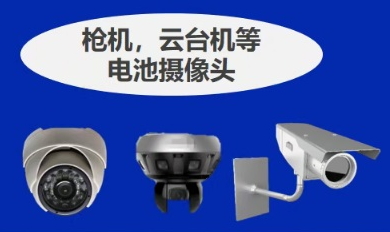
►Scenario application diagram
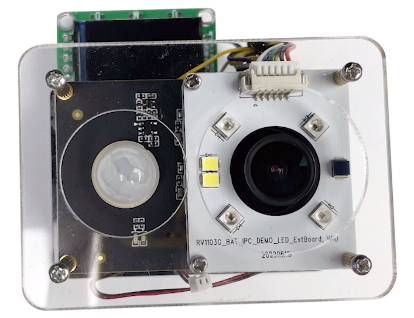
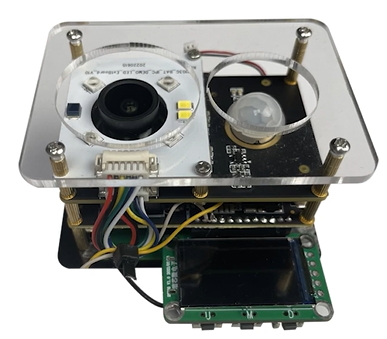
►Display board photo
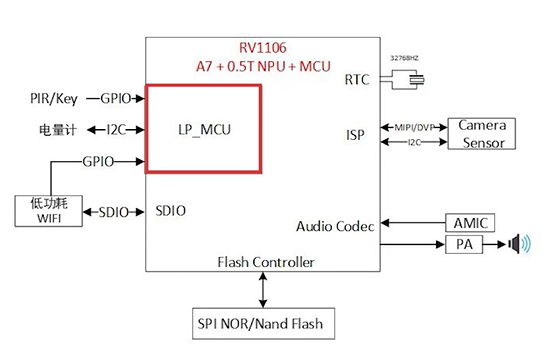
►Solution block diagram
►Core technical advantages
1. 4th generation NPU, up to 1.0TOPs computing power
The low-power battery IPC solution uses Cortex A7 CPU and RISC-V MCU, with built-in Rockchip's self-developed 4th generation NPU, which has high computing accuracy and supports int4, in8, and int16 mixed quantization. The int8 computing power is 0.5TOPs, and the int4 computing power can reach 1.0TOPs.
2. The third generation ISP3.2 supports a variety of image processing technologies
The low-power battery IPC solution adopts the self-developed third-generation ISP3.2, which supports 5 million pixels and 4 million pixels respectively. It supports HDR, WDR, multi-level noise reduction and other image enhancement and correction algorithms. In various complex light scenes, it can achieve clear black-light full-color, backlight and strong light shooting effects. The low-power battery IPC solution can support 2-3 MIPI/DVP inputs and is the preferred economical binocular IPC solution.
3. Strong coding ability, high frame rate, low bit rate, small space occupied
In terms of video encoding, the low-power battery IPC solution has super encoding performance, supports smart encoding, and self-adjusts to save bit streams according to the scene. It saves more than 50% of the bit rate compared to the conventional CBR mode, making the captured images high-definition, small in size, and doubling the storage space. It also supports rich encoding functions, such as frame skip reference, custom quantization matrix, subjective factors, etc., to further improve encoding quality.
4. Intelligent audio, clearer sound recording
In terms of audio processing, the low-power battery IPC solution adopts a smart audio solution that supports echo cancellation, voice noise reduction, cry detection, abnormal sound detection, etc., supports high-definition voice, and enhances sound collection and pickup distance.
5. Quick start transient response, high performance and low power consumption
The design of the low-power battery IPC solution chip with built-in RISC-V MCU supports low-power fast startup, supports 250ms fast image capture, and loads the AI model library at the same time, enabling face recognition to be completed "within 1 second".
6. High integrationThe low-power battery IPC solution chip has built-in Audio codec, MAC PHY, RTC, etc., and SIP 64~256MB DRAM. There are a variety of packages for customers to choose QFN88, QFN128 and BGA.
►Project specifications
1. Video Input: supports SC3336 sensor (onboard) 2. Audio Interface: supports speaker output, single MIC recording 3. WiFi: Support SDIO WIFI 4. UART Debug: Users can debug and view SOC LOG information, and also use it for system firmware upgrades. 5. PIR: Support PIR wake-up function 6. Ambient Light Sensor: supports light sensitive detectors 7. DC Power: TypeC interface or rated voltage 3.7V battery power supply interface; system firmware upgrade channel
