

With the development of sensor sensor technology, the low-light performance of security cameras has been greatly enhanced.
In a dark environment, with the help of weak light or even starlight, the camera can still capture clear and colorful surveillance images.
All major brands have launched full-color cameras. Security video surveillance has entered the starlight full-color era.
Compared with traditional infrared night vision, the advantages of starlight full-color cameras are:
1. The image is in color and presents more content than the infrared black and white image. Real-time monitoring and post-event investigation and evidence collection can obtain more information;
2. No additional infrared lights are needed, no light pollution, and better concealment;
3. There is no additional fill light, and the power is relatively smaller at night, which is more conducive to POE power supply. At the same time, the heat generation is smaller, and the camera and system are more stable and reliable;
4. There will be no infrared overexposure, flashlight effect and other defects of traditional infrared cameras, so you can see more clearly.
5. Some special scene applications. For example, in a parking lot at night, after the headlights are turned on, the infrared camera may not be able to see the license plate and the front of the car at all. The full-color camera perfectly solves this problem, and the license plate and front of the car are clearly visible.
Before discussing starlight full-color technology, let’s first understand a few basic concepts.
01—Illumination
Illuminance (English: Illuminance) is the luminous flux received per unit area. The unit is lux (lx=lux).
When a candle illuminates an area of 1m2, the brightness it displays is approximately 1lux.
The following table shows the illumination values of some common scenes
| Illumination (LUX) | light conditions |
|---|---|
| 100 000 | The scorching sun |
| 50 000 | operating room |
| 10 000 | Clear sky |
| 500 | office |
| 5 | street lamp |
| 0.2 | full moon |
| 0.02 | Moonlight night |
| 0.0002 | starlight |
Of course, the above illumination value is just a reference value and is not that accurate. Similarly, in the field of video surveillance, there is no clear standard for what illumination camera is considered to be starlight-level, which will be discussed in detail later. Generally, the camera's photosensitivity mainly depends on the lens and image sensor. The lower the specified lux value, the better the camera's photosensitivity.
Typically manufacturers specify the minimum illumination level required for a camera to produce an acceptable image. While such specifications are useful for comparing the sensitivity of cameras from the same manufacturer, they are less useful for comparing cameras from different manufacturers. This is because different manufacturers use different measurement methods and have different criteria for generating acceptable images.
02—Starvis
The concept of starlight cameras has always existed in security, but the naming of more professional systems should come from SONY.
SONY names some of its own back-illuminated CMOS sensors with excellent low-light performance as the starvis series. This should be the source of the name of the Starlight full-color camera.
For Starvis, Sony’s official explanation is visibility under the starlight, which means it is visible under the starlight. Of course, the industry has interpreted it as starvision. The starvis logo is registered and certified by Sony and is generally not allowed to be used freely without authorization.
Regarding Starvis technology, Sony defines it this way: STARVIS is a back-illuminated pixel technology used in CMOS image sensors for surveillance cameras, with a sensitivity of 2000mV per 1µm2 or more (color specification product, 706cd/m2 light source imaging, F5.6, 1s accumulation equivalent).
This technology is mainly used in back-illuminated CMOS sensors because it can receive light from the back side of the sensor silicon substrate, increasing the amount of light entering, reducing light loss, and improving sensitivity.
Any sensor with a sensitivity of 2000mV or above per 1µm2 area is called a starvis sensor. So how to measure the performance differences of different starvis sensors? Sony has proposed the SNR1s concept again.
03—SNR1s
Sony uses SNR1s as one of the indicators for quantitative evaluation of the low-light image quality of CMOS image sensors used in surveillance cameras.
SNR1s is a new indicator independently promoted by Sony and is limited to CMOS image sensors used in surveillance cameras. The smaller the value, the better the image quality under low illumination.
The SNR of SNR1s is "signal-to-noise ratio", 1 is "the signal amount when the noise is 1 is 1", and s means "monitoring purpose"。
Measurement conditions specified for SNR1s
| application | security surveillance camera |
|---|---|
| light source | 3200 [K] |
| target object | 18% gray |
| F value | 1.4 |
| Exposure time | 1/60(s) |
| linear matrix | 无 |
| Signal | G [e-] |
| noise | √Shot Noise[e-] 2 + Dark Noise[e-] 2 |
| Signal: Noise | 1:1 |
SNR1s measurement method
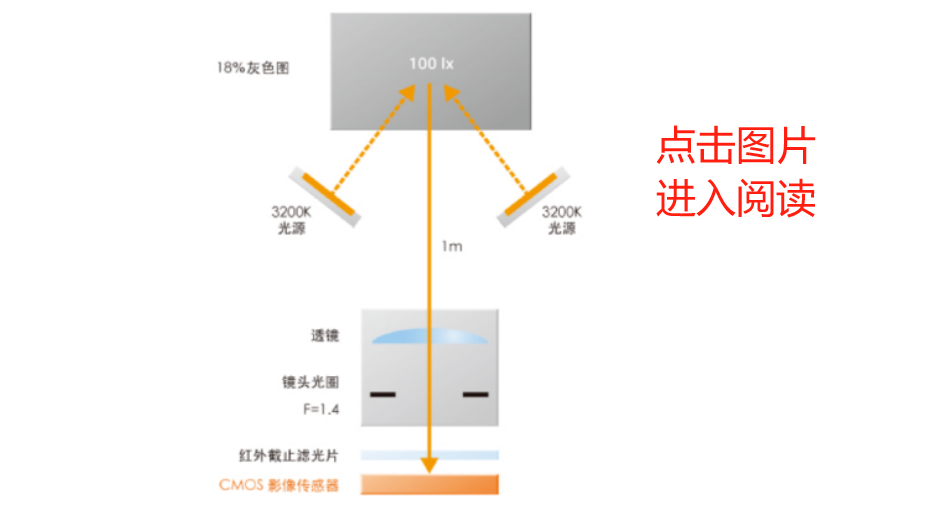
Illuminate the 18% gray image with a light source of 3200 [K] from two directions and adjust it to 100 [lx]. Place the camera at a position 1m away from the imaging surface of the image sensor from the gray image. Measure the sensitivity [e-] and dark noise [e-], and calculate SNR1s [lx] through the relationship.

When the value of this equation is 1, the corresponding illumination is SNR1s[lx].
SNR=G[−e]ShotNoise[−e]2+DarkNoise[−e]2=G[−e]G[−e]+DarkNoise[−e]2
SNR1s values of some common Sony sensors
| model | parameter | SNR1S value |
|---|---|---|
| IMX178 | 1/1.9′,2.4µm,5.3M | 0.26 |
| IMX226 | 1/1.7′,1.85µm,12.4M | 0.53 |
| IMX385 | 1/2′,3.75µm,2M | 0.13 |
| IMX307 | 1/2.8′,2.9µm,2M | 0.24 |
| IMX327 | 1/2.8′,2.9µm,2M | 0.17 |
| IMX334 | 1/1.8′,2.0µm,4K | 0.33 |
| IMX335 | 1/2.8′,2.0µm,5M | 0.33 |
| IMX415 | 1/2.8′,1.45µm,4K | 0.52 |
04—Four major factors affecting camera low illumination
The photosensitive performance of the image sensor is one of the core factors that determines the low-light effect of the camera. In addition to Sony's Starvis series CMOS back-illuminated sensors introduced above, domestic manufacturers have also introduced some sensors with better photosensitive performance. The overall performance is still far behind Sony, but it is cost-effective (cheap) and in line with the current concept of independent control of the domestic chip industry. Therefore, the market share is still very high, and the future is promising!
2. Large aperture lens
The larger the aperture, the more light is taken in through the lens and onto the sensor, which can only lead to better effects.
The square ratio of two adjacent aperture numbers in the full-level aperture value is 1:2. Therefore, the illumination of the lens between two adjacent aperture values is twice as different. In other words, the amount of light entering an F1.0 aperture lens is twice that of an F1.4 lens.。
Another thing to note is that the larger the lens aperture, the smaller the depth of field.
The noise reduction and automatic gain capabilities of the ISP in the video encoding chip will affect the final imaging effect.
4. Algorithms such as low illumination enhancement
When the performance of all hardware is the same, what ultimately determines the low-light performance of a product is the algorithm and optimization capabilities of each manufacturer. For example, a certain AI algorithm can be used to restore the input incomplete information. Some even use dual-sensor modes, with one black-and-white sensor providing more detail and one color sensor providing color. The two images are then combined to enhance the camera's low-light capabilities.
