What is the difference between high-definition camera starlight, super starlight, and black light?


Traditional low-light cameras include infrared cameras and slow shutter cameras, but starlight cameras, which have become popular in the security field in recent years, are widely favored. Although traditional infrared fill light technology can obtain clear images under low illumination, it will lose color and can only form black and white images. Moreover, through infrared fill light, highly reflective objects such as license plates are easily overexposed. The color of clothing, car body color, license plate, etc. are often key clues in solving crimes and cannot be lost. The slow shutter type improves image brightness by reducing the video frame rate. It has a tailing phenomenon for monitoring moving objects and is generally not commonly used.
Therefore, there is an increasing demand for clear color imaging under low illumination, and this is one of the reasons why starlight-level cameras were very popular when they were first born.
Starlight camera, literally speaking, means that it can still obtain relatively clear images under extremely low light brightness.
Currently common in the marketStarlight, super starlight, black lightWait for the camera.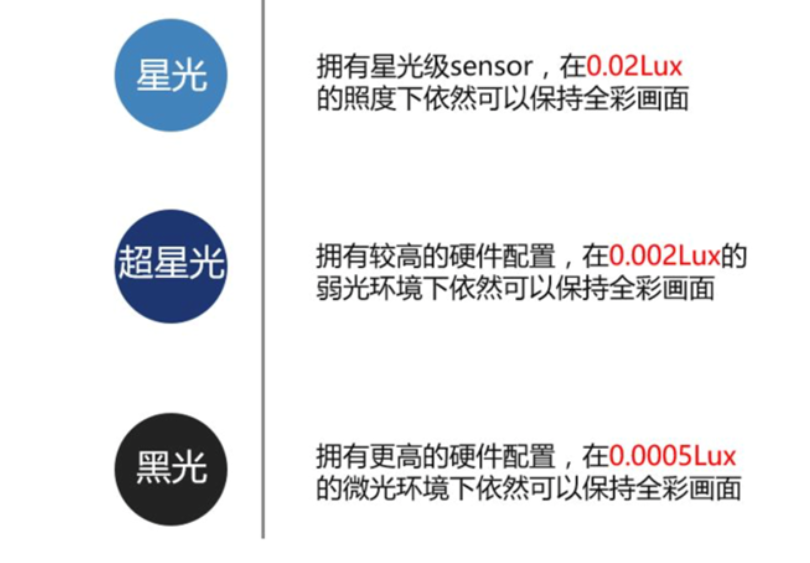
Remark:The switching illumination defined by different manufacturers may have certain differences due to different hardware.
Starlight camera:It can also display color images under an illumination of 0.02lux. When the infrared light is turned on at night, it will automatically convert to black and white images.
Super starlight camera:With high hardware configuration, it can maintain color images in 0.002LUX low-light environment. When the infrared light is turned on at night, it will automatically convert to black and white images.
Black light camera:With higher hardware configuration, it can still maintain color images in 0.0005LUX low-light environment. We know that video images are indispensable with the two elements of color and brightness. However, the interference between color and brightness will eventually affect the picture effect. Black light cameras can imitate the principle of retinal imaging of the human eye and solve this contradiction well. The black light camera innovatively adopts a dual-sensor architecture. One sensor imitates the cone cells in the retina to perceive color information, and the other sensor imitates the rod cells in the retina to perceive brightness details. Color information and brightness details do not interfere with each other, and the imaging effect is greatly improved. The video image at night is brighter, cleaner, and the colors are more realistic. It is also equipped with warm light and infrared lights to form all-weather monitoring.
The black light camera meets the environmental requirements for full-color imaging in low-illumination scenes. It integrates a number of black technologies to comprehensively improve the nighttime surveillance effect, providing colorful, clear, and translucent surveillance images, effectively improving the ability to capture detailed information. It not only solves the problem of traditional cameras losing color information due to infrared fill light, but also solves the problem of starlight cameras causing excessive picture noise due to insufficient ambient light at night. Achieve the effect of "seeing and seeing clearly". The emergence of black light marks the coming of an era of full-color surveillance where night is like day.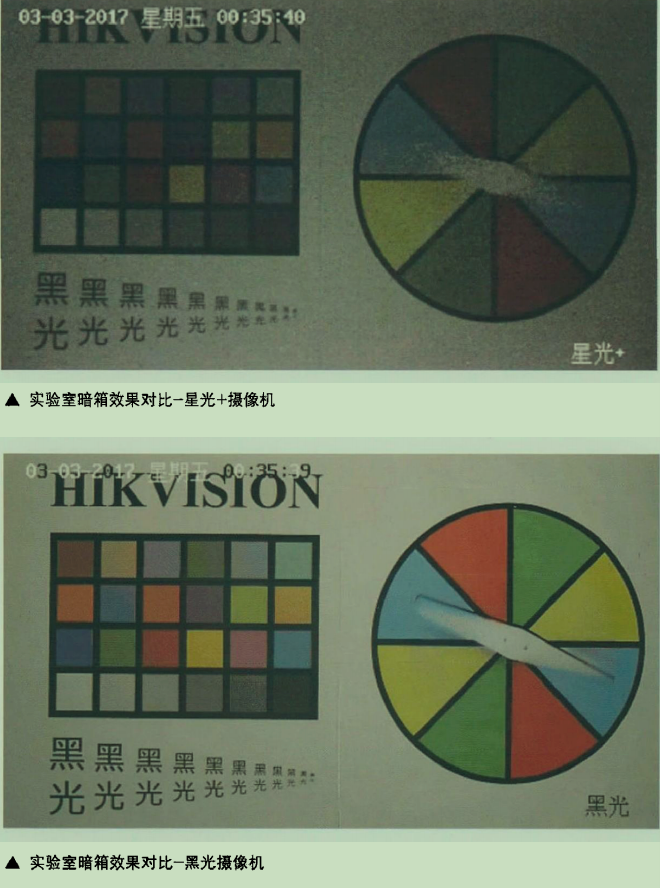
The camera image effect is mainly affected by many factors such as the lens, image sensor, and image processing technology. In order to achieve a more ideal low-light monitoring effect, it can be improved from the following aspects:
1. Use a large aperture lens:The lens is an important part of the camera component. Its function in low-light surveillance application technology is to focus the light of the subject for the camera. The key to low-light applications and technology here is that the larger the diameter of the lens, the greater the amount of light that will enter. That is, the increase in the lens aperture can effectively increase the amount of light that enters, so that the camera can obtain the ideal low-light effect.
2. Choose a large target area sensor:The essence of a camera is to convert light energy into electrical energy, and the core component of quantification is the sensor. The function of the sensor is to photoelectrically convert light of different intensities transmitted to it into voltage information and finally generate digital image information. The part of the sensor that receives light is naturally the core of the core. For a camera with the same resolution, the larger the target area of the image sensor, the greater the amount of light entering per unit pixel, the stronger the ability to suppress noise, and the better the imaging quality when shooting at low illumination.
3、Good image processing techniques:Since the development of starlight cameras, not only have there been developments in hardware technology, but also outstanding performance in DSP image processing. For example, the emergence of color-to-black technology, frame accumulation technology, and noise reduction technology has greatly improved the effects of high-definition low-light cameras. As we all know, for image sensors with the same photosensitive area, the higher the pixels, the smaller the photosensitive area allocated to each pixel, the smaller the amount of light transmitted in one exposure cycle, and the worse the low-light effect. Due to the low illumination of high-definition network cameras, image noise will increase much more than when the light is better. Various digital image noise reduction algorithms have also been applied to high-definition network cameras. For example, three-dimensional filtering is used when processing static images, while two-dimensional filtering is used when processing dynamic images. Two noise reduction algorithms work together to preserve important details and make images smoother, and can minimize the smear caused by moving objects, while greatly improving the flicker of the video. In terms of noise reduction processing, the effect of low-light cameras can also be improved through subdivision of picture sampling, improvement of processing algorithms, automatic gain refinement, etc. After the processing is completed, the images can be merged to make the resulting picture appear clearer and more delicate.
With the progress of human society and the development of market economy, society's demand for security surveillance methods is becoming more and more urgent. The use of security surveillance methods can improve the security of society and make it easier and more efficient for law enforcement and special military operations personnel to perform their tasks. With the promotion of safe cities, smart transportation and other applications, the use of starlight-level low-illumination cameras will become more popular. Limited by the development of current technology, the cost of starlight-level cameras will be high, and customers' budget costs will also increase. This is also a weakness of the starlight-level camera market. However, whether it is now or in the future, cities, transportation and security will need low-light protection. We have enough reasons to believe that starlight-level cameras are no longer the choice for high-end projects, and they will definitely be used in more projects!
