QLED basic principles:
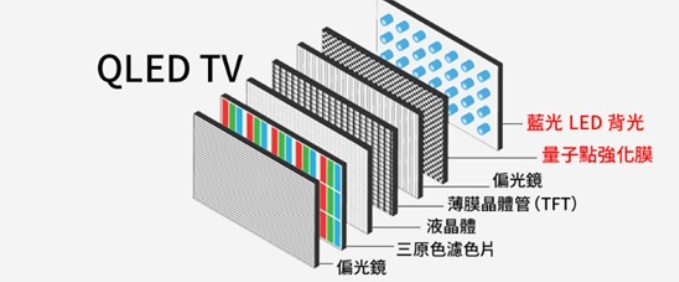
Traditional LED TVs use white LEDs as backlights, using TFT-LCD to control pixel light and dark, and RGB three primary color filters to control color, but the color accuracy is usually low. The Quantum Dots technology used by QLED uses "quantum dots" of different sizes implanted into QDEF (Quantum Dot Enhancement Film, quantum dot enhancement film) to produce pure red, green, and blue primary color light under the impact of a blue backlight. In addition to making the colors extremely accurate, it can still provide bright and saturated colors under high-brightness images without turning gray or white. Taking Samsung's QLED TV series as an example, it has passed Germany's VDE certification and achieved 100% color gamut under the DCI-P3 standard widely used in the film industry.
Introduction to micro-LED technology
Micro-LED and OLED have many similarities, so compared with LCD, the comparison between micro-LED and OLED is easier to understand. First of all, as you can see from the name, both of these have LEDs, so they are mainly composed of light-emitting diodes. Therefore, both technologies adopt the form of self-illumination. Each red, green, and blue sub-pixel can generate its own light source, unlike LCD, which requires a specialized backlight component. As a result, micro-LED displays offer the same extremely high contrast and black levels as OLEDs, while also having a TFT panel to power each pixel.
Micro LED technology, that is, LED miniaturization and matrix technology, simply put, is to thin-film, miniaturize, and array the LED (light-emitting diode) backlight, which can make the LED unit smaller than 50 microns. Like OLED, each pixel can be individually addressed and driven to emit light (self-illumination). Its advantage is that it not only inherits the characteristics of high efficiency, high brightness, high reliability and fast response time of inorganic LEDs, but also has the characteristics of self-illumination without a backlight. It is small, thin and light, and can easily achieve energy-saving effects.
From a structural principle point of view, Micro LED is simpler and more effective. The TFT substrate, ultra-fine LED chips, and driver IC are not big problems. However, its biggest problem is the well-known mass transfer. How to make LEDs miniaturized, which requires wafer-level process levels. For example, a 4K-level Micro LED screen requires more than 8 million LEDs to be highly integrated, so in theory it is extremely difficult to apply to small-size screens. At the same time, the cost and heat generation are also extremely considerable. This is also the reason why Samsung chose 146 inches for its first Micro LED TV.
The difference between micro-LED and OLED lies in the material composition of its LED part. The "O" in OLED stands for organic material, which refers to the use of organic materials in the stack of pixels that produce light. Micro-LED technology uses inorganic gallium nitride materials, which are commonly used in ordinary LED lighting products. This technology can reduce the requirements for polarization and encapsulation layers, making display panels thinner. Therefore, micro-LED components are very small, with a width of less than 100 μm, which is thinner than a human hair.
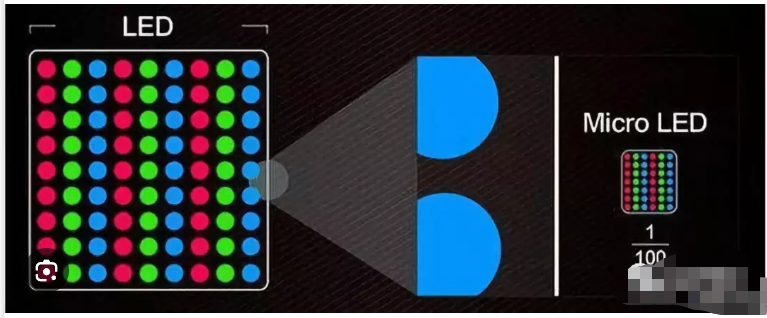
If you look at this problem from another perspective, micro-LED is traditional LED arranged in an array in a smaller way. LEDs are not actually a new technology, but sequencing arrays on such a small panel of components is the real difficulty. Contrary to other display panel technologies, micro-LED screens used in small-sized devices such as smart watches and smartphones are easier to manufacture. Facts have proved that it is very difficult to increase the area of micro-LED display panels. Of course, due to the high requirements for welding precision, it is also very difficult to compress a higher resolution to the size of a smartphone screen.
An unsolved problem for panel manufacturers is how to move large numbers of LEDs onto control circuit boards. One potential solution is to centralize the LEDs into a larger array and then solder them to complete the display. But the problem with this approach is that the current selection and manufacturing accuracy is ±34μm, which does not meet the ±1.5μm accuracy required by micro-LEDs.
An alternative is to etch the LED array to connect to the IC, or transfer a separate TFT layer to the LED array. These etching methods avoid the precision issues of wafer welding, but are also expensive and difficult to implement to meet the small-size component requirements for micro-light-emitting elements and high-resolution displays. At present, the progress of the entire manufacturing industry in this aspect is very slow, so if we want to increase production, we need to continue to improve.
In the short term, round crystal bonding appears to be the most feasible process. However, this product is currently only suitable for low-pixel panels, such as smart watches that do not require high resolution, rather than QHD resolution smartphones. Manufacturing high-resolution micro-LED panels is the goal of many manufacturers, but this requires continuous improvement of manufacturing precision.
Despite the manufacturing hurdles, micro-LED technology is still worth looking forward to because it offers more advancements than OLED. The first thing is the reduction of power at maximum brightness. That is to say, under the same low power conditions, micro-LED can achieve greater brightness. In comparison, the power consumption is 90% lower than LCD and 50% lower than OLED. This is a huge attraction for portable products like smartphones where battery life is at a premium, meaning reduced screen power consumption and longer use time. Compared with current OLED and LCD, manufacturers can increase the brightness of the panel and better use it under direct sunlight.
In addition, the display life of micro-LED is also longer than that of OLED. OLED screen burn-in is still a big problem because organic materials have a limited service life, especially blue OLED panels. Micro-LED has no such concerns and even lasts longer than LCD before color conversion.
The smaller size of micro-LEDs can also make high resolutions easier to achieve, such as 4K or even 8K resolution smartphones or virtual reality screens. Speaking of virtual reality technology, the response time of OLED panels has been reduced to the microsecond level, with a very good response time level. This makes them ideal for virtual reality applications. After changing to micro-LED, the response time was further reduced to the nanosecond level, which is 1,000 times faster.
In addition to the above advantages, micro-LED also has greater advantages in the fields of contrast, color gamut and flexible display screens. These make micro-LED an advantage when compared with OLED, but the manufacturing price and cost of micro-LED are also much higher, even three to four times that of current LCD or OLED panels. There is no doubt that this will increase the cost of products a lot and even affect investment in the entire industry. After all, many manufacturers are still expanding their OLED screen production lines.
Mini LED technology introduction
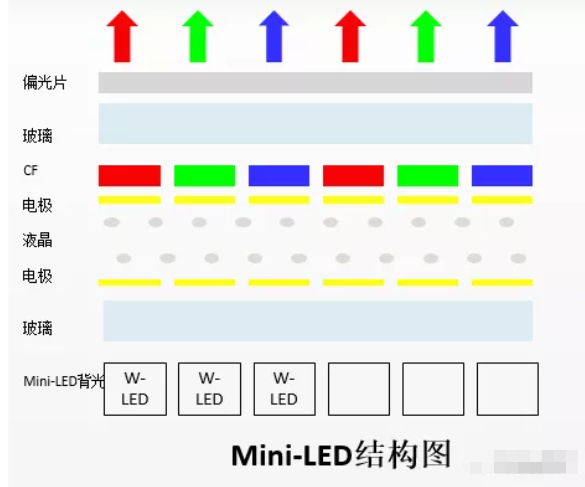
Mini LED, also known as "sub-millimeter light-emitting diode", refers to LEDs with a grain size of about 100 microns, which was first proposed by Epistar. Mini LED is between traditional LED and Micro LED. Simply put, it is an improved version of traditional LED backlight.
Compared with Micro in terms of manufacturing process LED has a high yield rate and special-shaped cutting characteristics. It can also be used with a flexible substrate to achieve a highly curved backlight. It adopts a local dimming design and has better color rendering. It can bring more refined HDR partitions to the LCD panel. The thickness is also close to OLED and can save up to 80% of power. Therefore, it is suitable for backlight applications such as power saving, thinness, HDR, and special-shaped displays. It is suitable for products such as mobile phones, TVs, automotive panels, and e-sports laptops.
Compared with Micro LED, Mini LED is theoretically less technically difficult, easier to achieve mass production, and can develop the LCD backlight market in large quantities, making the product more economical. According to industry estimates, an LCD TV panel using Mini LED backlight design will cost about 60% to 80% less than an OLED TV panel, but its brightness and image quality are similar to OLED, and its power saving efficiency is higher. At the same time, a 55-inch Mini LED backlight LCD panel uses 40,000 LEDs, which will be a positive help for LED chip manufacturers to reduce production capacity.
Generally speaking, Micro LED will provide a qualitative improvement in picture quality and is the next generation of revolutionary display technology, but the current technology is still not mature enough. Mini LED is an improved version of LED backlight, but it can still greatly improve the existing LCD screen effect. At the same time, the cost is relatively easy to control, and it is expected to become the mainstream of the market. We also hope that manufacturers can speed up the pace of research and development and bring Micro LED and Mini LED TV products that can satisfy ordinary consumers as soon as possible.