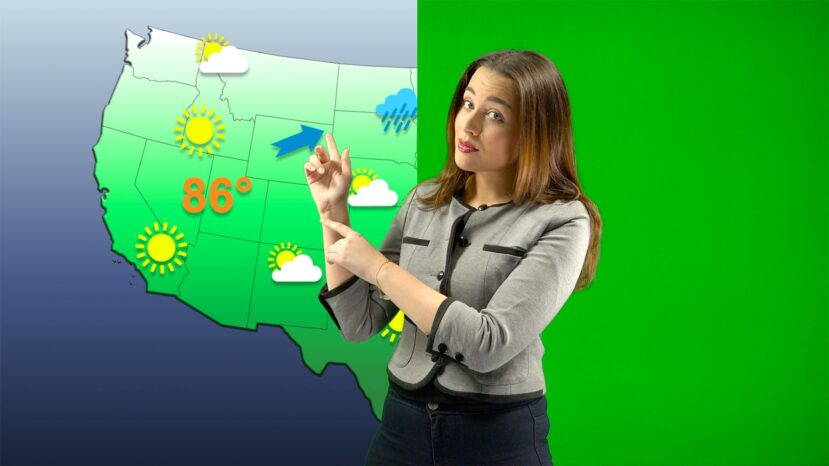
Chroma key or green screen technology
Chroma key is an effect that allows you to take a group of similar colors and make them transparent. It's often used to isolate an object in a video, transport a character to a distant place in a movie, or tell you the local forecast for the next week in a more vivid and visual way on TV news.
Set up green screen for weather forecast
In order to use chroma key effectively, we need two things. We need a video or image as our background, in this case our weather map, and we need a video of our subject, in this case our weatherman. We could make the background in Alight Motion, but for our weather forecasters we needed to shoot them ourselves. To do this, we need to make sure we're shooting them in a way that allows chroma key to work well.
For filming our weather forecasters, having a green screen large enough to fill the entire background behind them would be ideal. If you don't have a green screen, you can also use a wall, as long as it's fairly uniform in shape, a single, solid, bright color, and a different color than the subject or anything they're wearing. Greens and blues are usually the best choices, as reds/pinks/browns/oranges may resemble skin tones, while whites/greys/blacks generally don't work well with chroma key.
Setting up the correct lighting for your green screen
Once you have your position, it's important to light it evenly behind your subject. Any shadows on the background may change the color so much that it won't be well recognized by the chroma key, resulting in a loss of quality. Multiple light sources are better than one, and if you have a way to diffuse the light and make it softer, this will help avoid any harsh shadows.
Weathermen should stay as far away from green screens as possible, as light bouncing off the green screen may cause a green frame to appear around them, and they may cast shadows on the screen. At this point, the weatherman also needs to be illuminated. Since we're setting up for a weather forecast, there won't be any need for any special lighting, but be aware that you may want to set up different lighting based on the lighting in the shot that you plan to use as a background, so you can match that as closely as possible.
Depending on your setup, a ring light can really help you. They can be used on large cameras and cell phones and can evenly illuminate a subject's face or body, depending on size.
Collect weather information
To get precise weather measurements, meteorologists from around the world launch weather balloons, also known as radiosondes, twice a day at the same time. These balloons travel through the troposphere and measure air pressure, temperature, wind speed and direction. This information is transmitted directly to a ground station, forming a snapshot of the weather at a specific point in time. In addition to radiosondes, surface weather is measured at observatories around the world, buoys and ships at sea, and weather radars.
These measurements are transmitted to weather prediction centers located in the United States, United Kingdom, Canada, Australia, Germany and many other countries around the world. All of these centers are equipped with supercomputers that model the raw data to produce a three-dimensional grid showing changes in the atmosphere. Future changes in wind (vertical and horizontal), temperature, cloud water, water vapor and precipitation formation are calculated in a three-dimensional grid. The complex model also includes the effects of solar and infrared radiation on temperature. All these equations are run together as a program to generate a numerical weather forecast.